Showing posts with label News. Show all posts

Wednesday, June 22, 2011

Video: Enterprise Scalable NAS

Jeff Day, Marketing Manager from HP's StorageWorks division discusses why users should consider scalable NAS -- a next generation NAS technology. In this video, Jeff talks about what's driving the need for this new architecture, why it supersedes older NAS architectures and how HP is addressing this opportunity.


Run time: 15:53


Click video player to begin


SAN booting alternatives for data storage managers

What you will learn in this tip: 

Storage-area network (SAN) booting and server virtualization are fueling the trend toward diskless servers. Learn about the move from internal to external storage and other booting alternatives available for your organization.


Enterprise storage has always implied the use of hard disk drives, but times are changing. The spread of server virtualization and the increase of SAN booting has created a new trend toward diskless servers. Server manufacturers have recognized this shift and are offering USB flash drives and SD card slots. This trend away from disk might seem threatening, but it actually increases the impact of enterprise data storage technologies.


Internal to external and networked storage :


Most enterprise application data resides on external storage, whether it's SAS, a direct-attached storage (DAS) array, an iSCSI or Fibre Channel (FC) SAN, or using network-attached storage (NAS). Networked shared storage (SAN and NAS) has become increasingly valuable

Saturday, June 18, 2011

SAN specialists not required for Exadata implementations

Oracle’s Exadata V2 appliance contains an Infiniband storage area network (SAN), but SAN specialists are not required to operate the device according to Peter Thomas, Oracle’s Senior Director for Exadata Solutions and Architecture.
Infiniband is a networking standard that is often found in high-performance computing environments, but is not a mainstream tool for storage area networks or server interconnects due to its expense. Thomas says Oracle chose the technology to make the Exadata appliances as fast as possible.
“We call Exadata a ‘balanced an optimised configuration,’” Thomas told SearchStorage ANZ. “Customers have told us that when they try to scale Oracle applications they find they have too much storage and too little CPU, or the reverse.” By building the SAN and servers into a single system, Thomas says Exadata aims to give users sheer speed without the need to tune networks, SANs and other components to achieve the results they desire from their applications.
“SAN vendors make general purpose storage,” he says. “We are creating an environment for Oracle applications so you can run Oracle faster than is possible in any other environment.”
The devices therefore include the Infiniband SANs, which include dual 40Gb links, comprise a dozen disks and support either 600GB SAS or 2TB SATA drives. A tier of four solid state disks can also be included.
Thomas says the devices are aimed at organisations whose need for rapid data processing is paramount and that application specialists, not storage administrators, will likely operate Exadata machines.
“Database administrators will not need any new skills to operate Exadata,” he said, such is the level of abstraction of the SAN inside the device.
Storage professionals will, however, be involved in backing up Exadata devices. The machines boast Gigabit Ethernet ports, making iSCSI SANs a possible backup target. Thomas told SearchStorage ANZ that Exadata V2 also offers a spare Infiniband port and that Infiniband-to-fiber channel adapters are available for those organisations wishing to use fiber channel storage as a backup target.

Brocade, Emulex kick off 16-gig FC hype

Ready or not, 16 Gbps Fibre Channel is coming.
Emulex and Brocade this week said they have 16-gig FC devices being qualified by storage and server vendors, although there doesn’t appear to be any screaming demand for organizations looking for more than 8-gig FC support. The aggressive move to 16-gig FC is a sign that mass adoption of Fibre Channel over Ethernet (FCoE) is still a long ways off and pure FC has plenty of life left.
Emulex got the ball rolling Monday with its XE201 I/O Controller, a converged adapter that supports 16-gig FC along with FCoE, 10-Gigabit Ethernet (GbE) and 40 GbE. Emulex will demo the XE201’s 16-gig capability at EMC World next week.
Brocade Tuesday rolled out what it calls the first end-to-end 16-gig FC platform of products. They include the DCX8510 Backbone SAN switch with up to 384 16-gig ports at line-rate speeds, the 6510 edge switch with 24 or 48 ports, and the 1860 Fabric Adapter that supports FC, Ethernet and FCoE. Brocade is also adding 16-gig FC support to its Network Advisor 11.1 unified management software and Brocade Fabric Manager 7.0.
Brocade said the new switches and software will be available this quarter. However, its OEM partners probably won’t complete qualifications before August. EMC and Hewlett-Packard are already qualifying the 16-gig products with other storage vendors to follow soon.
Emulex VP of marketing Shawn Walsh said he expects OEM certification for the second half of this year for Emulex’s 16-gig adapter.
It’s no surprise that Brocade is pushing the faster FC. Brocade has always been less bullish on FCoE than its FC switch rival Cisco, and Brocade picked up significant market share gains by beating Cisco to 4 Gbps and 8 Gbps FC gear. During its tech summit day Tuesday, Brocade execs said the market agrees with their take on FC and FCoE.
“FCoE adoption has been modest,” said Jason Nolet, VP of Brodcade’s data center and enterprise networking group.
“Our customers say they want to stay with Fibre channel,” Brocade CTO Dave Stevens added.
Emulex’s Walsh agreed with that. “Ten-gig [Ethernet] adoption is happening fast, but there’s still discrete networks,” he said. “Customers are not going to throw away what they have today. One of the big questions we get is, ‘What is Emulex’s commitment to 16-gig Fibre Channel?’”
It’s almost certain that more vendors will have 16-gig FC products by the Fibre Channel Industry Association (FCIA)’s October 16-gig plugfest.
If history is any indication, Cisco will trail Brocade by from six months to a year with 16 Gbps FC. Emulex’s main adapter rival QLogic isn’t commenting on its 16-gig roadmap but is expected to support it this year.
Brocade execs point to virtualization and the cloud as drivers of the faster technology. However, there will be a price premium to move from 8-gig to 16-gig. That was also the case with the move from 4-gig to 8-gig, and that transition was slower than the moves from 1-gig to 2-gig and from 2-gig to 4-gig when there was no price hike for the higher bandwidth. While the first two transitions took about two years each for the higher bandwidth to become dominant, the move to 8-gig took about three years.
In a blog post this week, Wikibon senior analyst Stuart Miniman advised organizations to pursue 16-gig FC and converged networks on their internal schedules rather than according to vendor roadmaps.
“Most users can take a slow and deliberate approach to the adoption of new generations of speeds,” Miniman wrote. “ … customers can support both FC and Ethernet and consider the migration on internal schedules rather than on the pace that the vendor community may want to push or pull. For equipment refresh cycles that start in 2012 or later, consider looking for adapters that can support the latest of both FC and Ethernet.”

FULL DETAILS: EMC’s new VNX and VNXe ranges

EMC will next week unveil its long-rumored unified storage systems, but will also surprise the market with a pair of new arrays for smaller businesses and remote offices that replicate to their larger cousins.
EMC has made it known that January 18th (Jan 19th in Australia) will see it launch new products it says will break performance records.
SearchStorage ANZ has been shown an EMC Education Services Sales Training document, titled “Q1 2011 EMC VNX Family Launch” that outlines the new products in detail. As expected, the new products replace and combine EMC’s CLARiiON and Celerra products. Indeed, the document sighted by SearchStorage ANZ dubs the new products a “Next generation platform that converges CLARiiON and Celerra.”
EMC will not necessarily sell the new arrays as unified storage, as the presentation we’ve seen suggests customers can “Start with file or block and EASILY upgrade to unified” (EMC’s emphasis).
Here’s a look at the new products.

(click on the image to see a larger version)
No rip and replace
Intriguingly, the document we have seen says “CLARiiON and Celerra platforms will continue to be offered” and that “Service and support will continue for years” for these products. Upgrades will remain on sale for the two older platforms as well.
“Investments in all scripts and CLI’s will be preserved,” is another message in the document that should reassure current EMC customers.
The appliances will be sold with bundles of software, named the “Total Efficiency Pack” and the “Total Protection Pack”. Software in these collections has been renamed the “VNX Series Software” but comprises familiar EMC products.

(click on the image to see a larger version)
The document we’ve seen makes no mention of speed, but does offer some hints about how the new devices boost performance.
Fiber Channel over Ethernet connectivity is included, and several mentions are made of increased use of solid state disks and practises that resemble tiering, hierarchical storage management and information lifecycle management (the latter topics have been EMC staples for nearly a decade).
Many mentions are made of Atmos, which EMC currently bills as a tool to create storage systems at petabyte scale, as the technology enabling the unification of file, block and object storage.
On the disk side, the new systems support SAS and NL-SAS, but fibre channel drives have been shown the door.
VNXe series
While the market expected an announcement of a CLARiiON and Celerra replacement, the release of the VNXe will come as a surprise to many.
The range starts at less than $US10,000 and comprises two devices.

(click on the image to see a larger version)
Competitive positioning
EMC believes its new products line up well against competitors, but the document we have seen is at pains to compare the VNX range with NetApp’s FAS 3000 and 6000 series, IBM’s XIV and HP’s recently-acquired 3Par range. The VNXe is compared to Dell’s EqualLogic, HP’s MSA P2000 and NetApp’s FAS 2000.
For what it’s worth, here’s how EMC sees the new products’ places in the market.
(click on the image to see a larger version)

(click on the image to see a larger version)

EMC is running an effort called “operation MOJO” to take the new products to market, and has adopted the slogan “refuse to lose”. The company says that at launch it will need to quickly convert current CLARiiON and Celerra prospects to the new VNX and VNXe range.
Virtualisation
Virtualisation is a big focus for the launch, as the new products have been tuned to support VMware and to be easy to use in virtual environments.
The documents we’ve seen mention three scenarios as very likely uses for the VNX range. Those scenarios are:
•         Virtualizing Microsoft Applications with VMware vSphere;
•         Implementing Oracle in a VMware Environment;
•         Implementing Virtual Desktops with VMware View.
The VNXe range is also said to be useful in virtual environments, for two reasons:
•         Virtualizing Microsoft Applications with VMware Essentials
•         Virtualizing Microsoft Applications with Hyper-V
SearchStorage ANZ will bring you more news of the new products as it becomes available.

EMC combines Clariion, Celerra into VNX unified storage

As EMC counts down the seconds to its product launch set for next Tuesday, details have leaked about its upcoming and long-awaited unified storage system combining the Clariion and Celerra platforms.
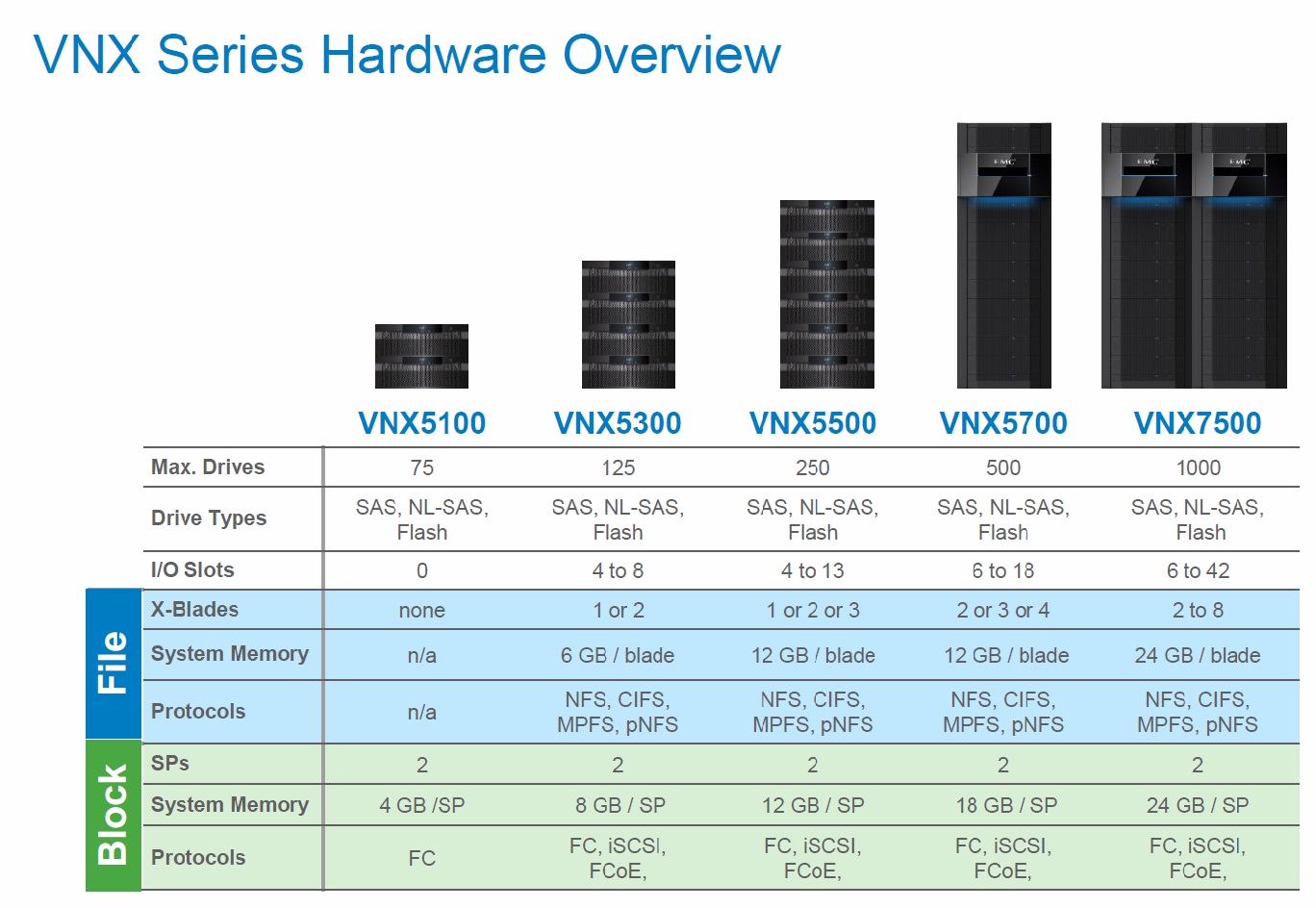
According to published reports and other leaks, EMC is preparing to launch a VNX family of products that includes code from the Clariion Flare and Celerra Dart operating systems on a common hardware platform. The new systems include several midrange models – the VNX 5100, VNX 5300, VNX 5500 and VNX 7500 – as well as VNXe 3100 and VNXe3300 SMB systems. The systems will be available as block storage, file storage, or unified systems. The midrange systems were code-named Culham and the SMB systems went by the code-name Neo.
The midrange systems will support Fibre Channel, iSCSI and Fibre Channel over Ethernet (FCoE) block storage and CIFS, NFS, MPFS and pNFS on the file side. The SMB systems support iSCSI, CIFS and NFS.
The midrange systems will include the management features EMC rolled out for the Clariion earlier this year – including FAST automated tiering and block compression – as well as Clariion’s data protection software.
On the hardware side, there is one notable departure from existing EMC systems. The new systems will not support Fibre Channel hard drives. The midrange family supports Flash solid state drives (SSDs) and SAS for performance and nearline (NL)-SAS for capacity. The SMB systems support SAS and NL-SAS.
All the new systems will support VMware integration with the vStorage API for Array Integration (VAAI) and Virtual Storage Integrator (VSI).
None of the new systems are surprises. EMC executives admitted last April that they would converge the Clariion SAN and Celerra NAS platforms, after denying a consolidation move was under way when talk first began circulating. EMC added a Unisphere unified management console for the two platforms last year. And EMC CEO Joe Tucci began teasing the new SMB system last July.
The big question now about Tuesday’s launch is whether it will include other products. EMC is believed to be close to rolling out new Data Domain, VPlex and Isilon systems, but the timing of those releases is unclear.

EMC ready to roll out Symmetrix VMAXe against 3PAR, XIV

EMC is preparing to launch a baby Symmetrix VMAX system called the VMAXe, which lacks mainframe connectivity and fills the gap between the vendor’s midrange VNX unified storage platform and the enterprise VMAX. EMC is positioning the new system squarely against Hewlett-Packard’s 3PAR and IBM’s XIV storage systems, other enterprise SAN arrays that are not built to connect to mainframes.

EMC is planning to make the system generally available this month and officially launch it in July. While its customers and partners are still under non-disclosure agreements, we’ve seen EMC documents that lay out the underlying technology, hardware specifications and the vendor’s positioning of the product.

EMC still recommends the VMAX for customers that need more capacity, data at rest encryption, hardware compression, SRDF remote replication or the ability to attach to a mainframe.

“VMAXe gives us a specific competitive advantage against some of the industry’s newer arrays, especially if you have any IBM XIV or HP 3PAR in your accounts,” read an EMC document for its sales team.

The EMC documents say the VMAXe can also compete with higher-end NetApp FAS arrays and entry level enterprise systems from IBM and Hitachi Data Systems.

The VMAxe uses a special build of the Enginuity operating system that powers the VMAX, and is 100% virtually provisioned – EMC’s version of thin provisioning. It supports FAST VP automated tiering and ships factory configured with a base software bundle that includes Timefinder for VMAXe for cloning and RecoverPoint splitter instead of SRDF for remote replication. Open Replicator and Open Migrator software are also available for moving data from competitive arrays onto the VMAXe.

EMC claims a VMAXe can install in less than four hours, and that 1 TB of storage can be provisioned in less than three minutes.

The VMAXe hardware supports up to four engines and 960 drives. An integrated system bay holds one engine and 150 drives, and a fully populated system has two additional drive bays with 180 drives apiece. The VMAX supports eight engines and 2,400 drives. VMAXe uses a dual-core engine while VMAX uses a quad-core engine.

Among other differences, VMAXe has 96 GB of memory cache per engine compared to VMAX’s maximum of 128 GB, VMAXe has 64 Fibre Channel and 32 Ethernet ports while VMAX supports twice as many of each, and VMAXe scales to 1.3 PB usable capacity compared to VMAX’s 2 PB.

The VMAXe also comes with pre-selecting drive tiering configurations. A single-tier system is all 450 GB 15,000 rpm Fibre Channel drives, a two-tier system comes with 97% 2 TB SATA drives and the rest 4 Gbps FC 200 GB Flash drives, and a three-tier system has 65% SATA, 32% Fibre Channel and 3% Flash. The system’s host connectivity options include 8 Gbps Fibre Channel, Gigabit Ethernet (GbE) and 10 GbE iSCSI, and Fibre Channel over Ethernet (FCoE).

EMC estimates the VMAXe will cost about 15% to 20% below smaller VMAX configurations and 5% to 10% below a three-engine VMAX. The VMAXe cannot be upgraded to a VMAX.


Follow storageadmiins on Twitter Follow storageadmiins on Twitter